


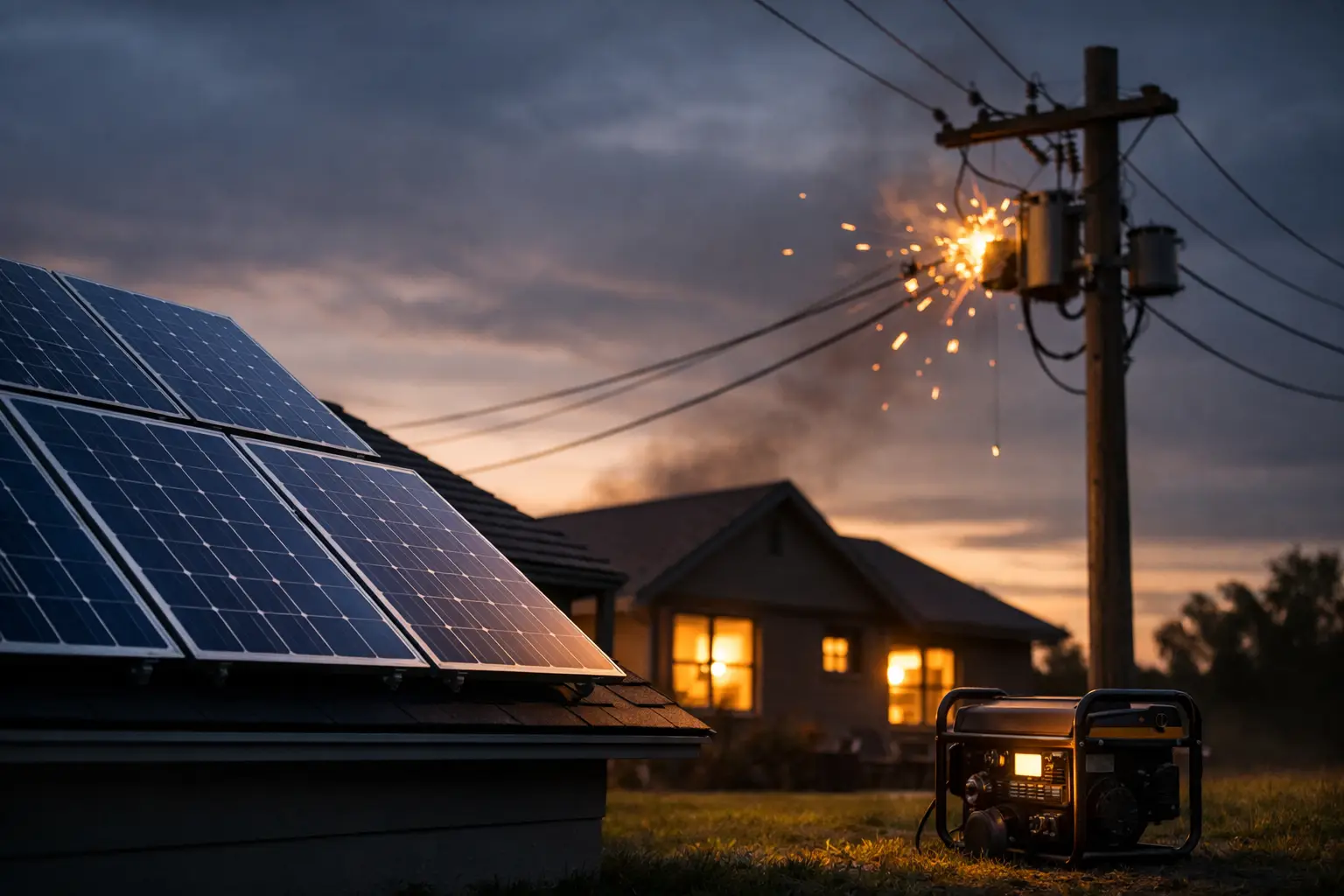
Does Solar Work During Outages?
The surprise for many homeowners comes after their first blackout. The sun is out, the panels are on the roof, and yet the lights inside are off. So, does solar work during outages? Sometimes – but not by default.
That answer matters a lot in Southern California, where utility shutoffs, grid strain, and extreme heat can turn a short outage into a real disruption. If your goal is lower electric bills, solar alone can do that well. If your goal is keeping your refrigerator, Wi-Fi, medical devices, or business equipment running when the grid goes down, your system needs to be designed for backup.
Does solar work during outages without a battery?
In most cases, no. A standard grid-tied solar system shuts down during a utility outage, even if the sun is shining and your panels are producing power.
This is not a flaw. It is a safety feature called anti-islanding. When the grid goes down, your solar inverter is designed to stop sending electricity out. That protects utility workers who may be repairing power lines nearby. Without that protection, a home solar system could send energy back onto lines that crews expect to be dead.
This is why many people are surprised after installation. They assumed solar automatically meant backup power. In reality, traditional solar is built first to offset your electric bill, not to operate as a standalone power source during an emergency.
When does solar work during outages?
Solar can work during outages if your system includes battery storage and the right backup equipment. In that setup, the battery and inverter can separate your property from the grid and keep selected circuits powered.
Think of it this way. Your solar panels make electricity when the sun is available. Your battery stores electricity for later use. The backup controls manage when your home disconnects from the grid and what stays on during an outage. All three pieces need to work together.
For many homes, that means your critical loads stay on while nonessential appliances stay off. Your kitchen outlets, refrigerator, internet, a few lights, garage door, and medical devices may stay powered. A central air conditioner, electric dryer, or pool equipment may not – unless the system is sized specifically for those larger loads.
That is where planning matters more than marketing.
Why a battery changes the answer
A battery is what turns solar from a bill-saving system into a resilience system. Without storage, solar production has nowhere to go during an outage because the inverter is required to shut off. With storage, your system can keep using solar power and store excess production during the day for use at night.
This gives you a more practical kind of energy independence. Not total independence in every case, but real backup for the things that matter most.
For example, if an outage starts in the afternoon, your panels may help power the home and recharge the battery at the same time. If the outage continues into the evening, the battery can carry those essential loads into the night. How long that lasts depends on your battery size, your energy use, and whether the weather allows continued solar production the next day.
For business owners, the same idea applies. A battery-backed solar system can help keep point-of-sale systems, refrigeration, office equipment, lighting, and internet service running longer. But it needs to be designed around your actual operations, not just average monthly usage.
What can stay on during an outage?
This depends on your backup plan. Some systems are set up for whole-home backup, but many are designed for partial backup to keep costs manageable.
Partial backup is often the smarter choice for budget-conscious property owners because it focuses on the loads that matter most. In a typical home, that might include the refrigerator, freezer, lights in key rooms, internet, phone charging, televisions, and a few outlets. In some cases, homeowners also choose to back up a microwave, security system, or small mini-split.
Whole-home backup can work well, especially in larger properties or homes with multiple batteries. But it requires more storage and often more careful load management. If you want to run central AC through a long outage in August, for example, that is possible in some setups – but it increases system size and cost.
The right question is not just, “Can I back up my whole house?” It is, “What do I need powered, for how long, and at what budget?”
Common misunderstandings about solar outages
One of the biggest misunderstandings is that panels alone will power the home whenever the sun is out. They usually will not.
Another misunderstanding is that one battery means unlimited backup. It does not. A battery gives you stored energy, but every appliance you run draws from that supply. If you use less, your backup lasts longer. If you try to run everything as normal, it drains faster.
There is also a difference between occasional backup and daily savings. Some homeowners want a battery mostly for blackout protection. Others want to use the battery every day to avoid expensive utility rates in the evening. In many cases, a well-designed system can do both, but priorities should be clear from the start.
What Southern California homeowners should think about
Outages in our region are not all the same. Some are short and unexpected. Others are tied to wildfire risk, public safety shutoffs, or high-demand conditions. That means resilience is becoming part of the solar conversation, not just savings.
For homeowners in San Diego County, Orange County, Riverside County, Imperial County, and nearby areas, the local utility structure also matters. Time-of-use rates, high summer demand, and rising electricity costs make battery storage more attractive than it used to be. The value is not only backup. It can also be smarter energy use.
Homes with older electrical panels, roof issues, or planned upgrades may need a more complete project approach. That is often where people get stuck if they are talking to separate contractors for solar, storage, roofing, and electrical work. A coordinated plan can make the process easier and help avoid expensive rework.
How to know what system you actually need
The best starting point is not the number of panels. It is your outage goals.
If your priority is reducing your utility bill, a standard solar system may be enough. If your priority is keeping power on during blackouts, ask specifically about battery storage, backup panels, transfer equipment, and critical load planning.
A good consultation should cover how often outages affect your area, what equipment you want powered, how long you want backup to last, and whether partial or whole-home backup makes more financial sense. It should also include practical questions about your roof condition, electrical panel capacity, and whether financing is part of the plan.
This is especially important for families and business owners who want affordable monthly payments. Backup power is possible at different budget levels, but the design has to match real expectations. Overselling creates disappointment. Honest planning creates confidence.
Is solar with battery backup worth it?
For some customers, absolutely. For others, it depends on how they value reliability.
If outages are rare and brief, you may decide that solar for savings is enough. If you work from home, run a small business, store medication, have school-age kids, or simply want more control during grid problems, battery backup can be worth far more than its technical specs suggest. The comfort of staying powered during a disruption is hard to measure until you need it.
There is also a bigger picture for families trying to make energy more predictable. Utility rates can change. Grid conditions can change. A system with solar and storage gives you more flexibility than a system built for savings alone.
Accessible Solar & Energy Storage often sees this shift firsthand. Customers may start by asking about bill reduction and end up realizing they also want protection, convenience, and a better long-term plan for their property.
The real answer to does solar work during outages
Yes, solar can work during outages – but only if your system is built for it. Panels by themselves usually shut down when the grid fails. Solar plus battery storage and backup controls is what keeps power available.
That distinction matters because it helps you ask better questions before you buy. Not every home needs the same solution. Some people need basic savings. Others need reliable backup for everyday essentials. The best system is the one that fits your home, your budget, and the way you actually live.
If you are thinking about solar, this is a good time to look beyond the monthly bill and ask what energy security means for your household. A little planning now can make the next outage feel a lot less disruptive.


One Comment