


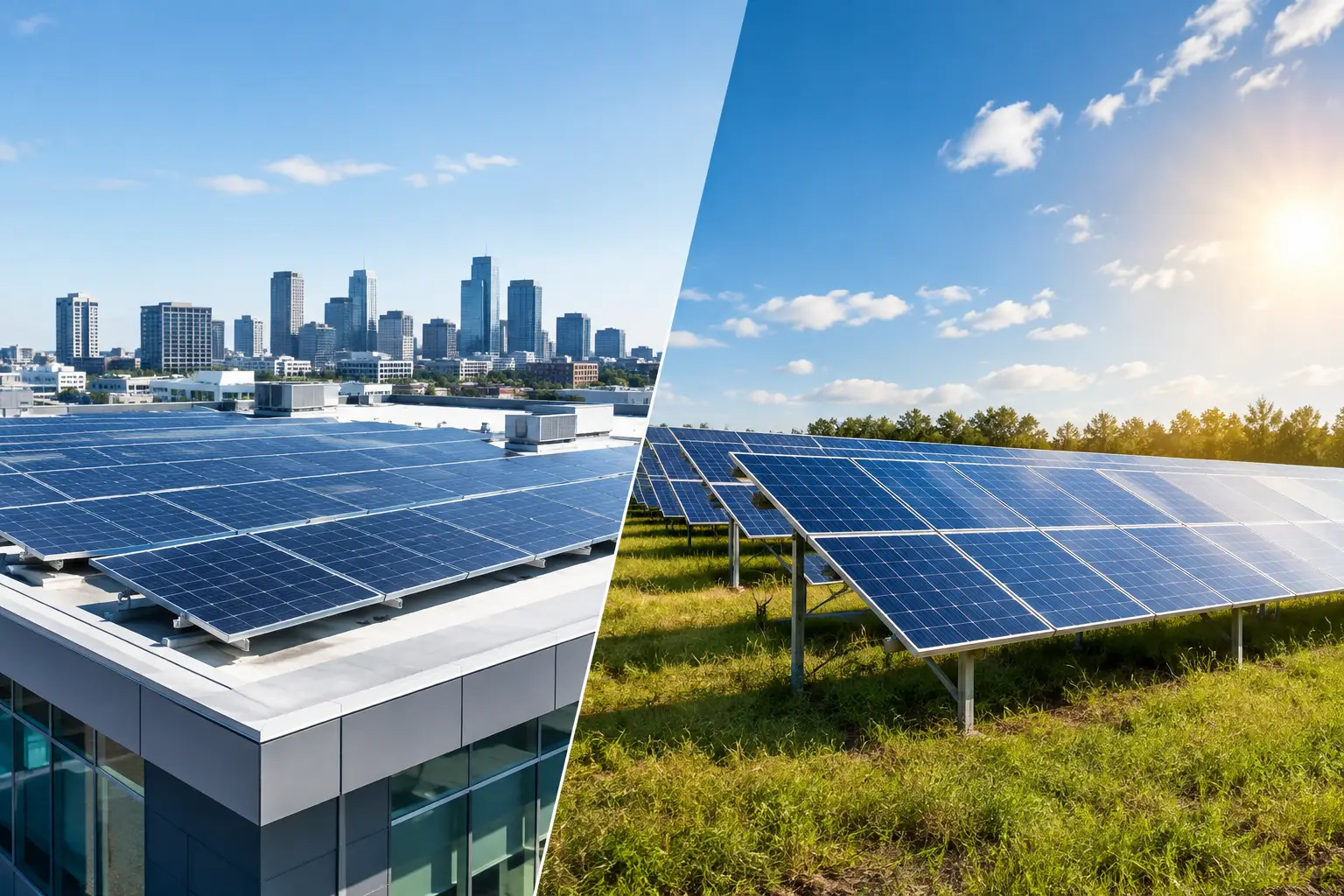
Commercial Rooftop Versus Ground Solar: Which Fits?
A warehouse roof that looks ideal from the street may need structural upgrades before it can carry a solar array. A wide open lot may produce more energy but also take away valuable space for parking, deliveries, or future construction. That is why the commercial rooftop versus ground solar decision should start with your property and business goals, not with a one-size-fits-all system design.
For businesses across Southern California, the right setup can reduce exposure to high daytime utility costs and create a more predictable long-term energy plan. The better choice depends on usable space, roof condition, electrical needs, permitting, budget, and how the property may change over the next 20 to 30 years.
Commercial Rooftop Versus Ground Solar: The Core Difference
Rooftop solar places panels on an existing building, typically using racking that is attached to or ballasted on the roof. It makes productive use of space you already own without changing traffic flow, landscaping, or ground-level operations. For many offices, retail centers, apartment buildings, schools, and light-industrial facilities, that is a major advantage.
Ground-mounted solar is installed on open land, parking areas, or other available ground space. Panels can be oriented and tilted for strong production, and the system is generally easier to access for maintenance. It can also support a larger array when the roof is too small, shaded, aging, or occupied by HVAC equipment.
Neither option is automatically better. A business with a large, newer, unshaded roof may find rooftop solar to be the practical path. A property with limited roof area and an unused side lot may get more value from a ground-mounted system. In some cases, a combined design is the best fit.
When Commercial Rooftop Solar Makes Sense
A rooftop system often works well when the building has enough clear, structurally sound roof area to offset a meaningful part of daytime energy use. It preserves land for customers, employees, storage, and operations. This matters for businesses where every parking space, loading lane, or square foot of usable ground has value.
Rooftop solar can also help keep the project contained within the existing building footprint. That may simplify site planning compared with building a separate ground array, although permits, interconnection requirements, fire setbacks, and structural review still apply.
The main question is not simply whether panels will fit. It is whether the roof is ready for them. A roof nearing the end of its useful life should usually be repaired or replaced before solar is installed. Removing panels later to reroof adds cost and disruption. For property owners already considering roofing work, coordinating the projects upfront can protect the solar investment and reduce the number of contractors involved.
Shade is another factor. Nearby trees, taller buildings, roof equipment, parapet walls, and vents can reduce production or limit panel placement. A professional site evaluation identifies these constraints early, rather than discovering them after a system has been designed.
Rooftop solar benefits
Rooftop solar uses underutilized space and can help lower building heat gain by shading the roof surface. It keeps the array elevated and out of the way of daily activity, while allowing the ground area to remain available for business use.
For many commercial owners, it also creates a clean visual story: the facility itself is helping power its operations. That can support sustainability goals without requiring a separate piece of land.
Rooftop solar trade-offs
Commercial roofs vary widely. Structural capacity, roof material, penetrations, drainage, access paths, and existing equipment all affect design and cost. Flat roofs may offer substantial area, but panels must be spaced to avoid one row shading another. Sloped roofs can provide a favorable angle but may face the wrong direction or have too many obstructions.
Maintenance access requires planning, too. Panels and racking must not block critical equipment or create difficult pathways for roof service teams. A good design protects both energy production and the long-term needs of the building.
When Ground-Mounted Solar Is the Better Choice
Ground solar is worth a serious look when a business has available land and wants more freedom in array size and orientation. Unlike a rooftop system, a ground array is not limited by roof shape, structural capacity, or rooftop mechanical equipment. It can be positioned to capture strong sunlight and expanded more easily when site conditions allow.
This flexibility is especially useful for agricultural properties, storage yards, large campuses, manufacturing sites, and businesses with land that has little operational value. A ground-mounted array may also be easier to inspect, clean, and repair because technicians can access it without going onto the roof.
Ground solar can be a strong option when the roof needs replacement, has extensive shade, or simply cannot support enough panels to make a meaningful impact on utility costs. If the business has high energy demand from refrigeration, equipment, charging, air conditioning, or long operating hours, the extra capacity may be important.
Ground solar benefits
Ground-mounted systems can be designed at an optimal tilt and direction for the site. They can avoid some of the physical limits found on commercial roofs and may support larger production goals. In certain locations, they can also be paired with battery storage and electrical upgrades as part of a broader energy plan.
Because the array is at ground level, future service can be more straightforward. That does not mean it is maintenance-free, but access is often easier than it is with a high commercial roof.
Ground solar trade-offs
Land is rarely truly free. A ground array may compete with future building expansion, vehicle circulation, outdoor storage, landscaping, drainage needs, or parking. Security fencing may be needed, and the system must be planned around setbacks, underground utilities, easements, and local zoning rules.
Ground solar can also require more site preparation. Grading, trenching, foundations, and longer electrical runs can add costs depending on the property. For a compact urban business site in San Diego or Orange County, usable land may be more valuable than the energy it could produce.
Compare the Costs Beyond the Panel Price
It is tempting to compare rooftop and ground solar based only on the quoted system price. A smarter comparison looks at the total project scope and the value created over time.
Rooftop systems may require structural engineering, roof work, specialized access, or equipment relocation. Ground systems may require grading, trenching, fencing, foundations, and site improvements. Either project may need electrical panel upgrades, utility interconnection work, or battery storage depending on the facility’s energy goals.
Energy production matters just as much as installation cost. A less expensive system that is heavily shaded or too small for your load may not deliver the value you expected. Conversely, a larger ground array is not necessarily the right investment if it consumes land your business will need in a few years.
Financing should be part of the conversation from the beginning. A clear payment structure helps business owners weigh projected utility savings against the cost of the upgrade. It also allows the project to be planned alongside roofing, electrical, and storage needs instead of treating each improvement as a separate surprise expense.
Do Not Overlook Battery Storage and Demand Charges
Solar produces the most electricity when the sun is out. Many commercial businesses use a large share of their electricity during those same hours, which makes solar especially valuable. But some facilities also face demand charges or have critical loads that need power after sunset or during an outage.
Battery storage can store some solar energy for later use and may help reduce reliance on the grid during expensive periods, depending on the utility rate structure and system design. It can also support selected backup loads, such as refrigeration, communications, lighting, security, or essential equipment.
Storage is not required for every commercial solar project. It adds cost, and the financial case depends on usage patterns, rate plans, backup priorities, and available incentives. Still, it is easier to evaluate storage while designing the solar system than to assume it will be simple to add later.
A Site Evaluation Gives You the Real Answer
The best commercial solar decision begins with an on-site review, not a guess based on satellite images. An experienced team should review the roof condition, available land, shade patterns, electrical infrastructure, utility bills, operating schedule, and future plans for the property.
For example, a business planning to add electric vehicles, new equipment, or expanded operating hours may need a system designed for tomorrow’s energy use, not just last year’s bills. A property owner considering a roof replacement may benefit from coordinating that work before installation. These details affect whether rooftop, ground-mounted, or a combined solar approach creates the best long-term value.
At Accessible Solar & Energy Storage, we help commercial property owners look at the full picture, including solar, batteries, roofing coordination, electrical upgrades, and financing options. The goal is not to push panels onto the first available surface. It is to build a practical plan that fits your property, budget, and business.
The right system should give your business more control without getting in the way of how you operate. Start with the space you have, the energy you use, and the future you are building toward.


Leave A Comment