


Backup Power for Businesses That Lasts
A brief outage can do more than turn off the lights. It can stop card payments, interrupt refrigeration, shut down internet-based systems, delay production, and send customers straight to a competitor. That is why backup power for businesses is no longer just a nice extra for large facilities. For many local companies, it is part of staying open, protecting cash flow, and keeping daily operations under control.
In Southern California, where energy costs are already a major concern, business owners are often dealing with two problems at once. They want protection from outages, but they also want a smarter way to manage utility bills. The right solution can help with both. The key is choosing backup power based on how your business actually works, not just buying the biggest system available.
What backup power for businesses really needs to cover
Not every business needs whole-building backup. In fact, many do better with a targeted plan that supports the circuits and equipment that matter most. A restaurant may need refrigeration, point-of-sale systems, emergency lighting, and ventilation. A small office may care more about internet, phones, computers, and security. A warehouse might prioritize loading systems, lighting, and inventory controls.
This is where many backup projects go off track. Owners sometimes start with the idea of “full backup” without first asking which loads are essential, how long they need to run, and what an hour of downtime actually costs. Those answers shape everything from battery size to whether solar should be included.
A practical backup strategy usually begins with a site evaluation. That means looking at electrical usage, panel capacity, critical equipment, operating hours, and building conditions. If roofing, electrical upgrades, or storage integration are needed, those should be part of the conversation early. It is usually more affordable and less stressful to plan the project as one coordinated upgrade instead of treating each piece separately.
The main options for backup power
Most businesses looking at backup power are comparing generators, batteries, or a combined solar-plus-storage setup. Each has strengths, and each comes with trade-offs.
Generators
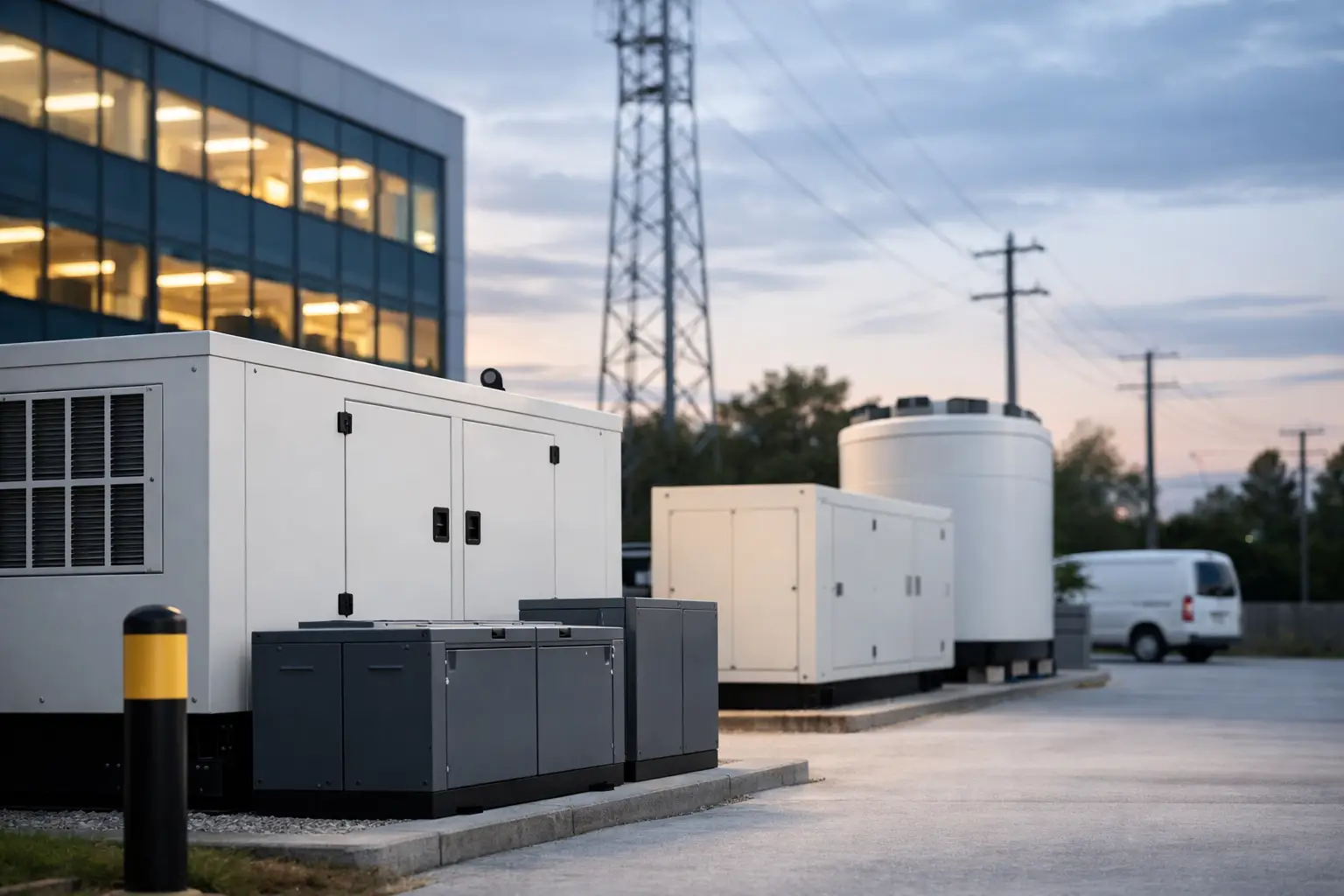
Generators are familiar and can provide substantial backup capacity, especially for large loads. They are often used when long runtime is the top priority and fuel access is reliable. For some commercial properties, they still make sense.
The trade-off is that generators need fuel, maintenance, and regular testing. They can also be noisy, and depending on the setup, they may not reduce monthly electric bills. They solve the outage problem, but not necessarily the broader energy cost problem.
Battery storage
Battery storage gives businesses quiet, instant backup power without fuel. When the grid goes down, a properly designed battery system can keep essential loads running automatically. For many business owners, that immediate response is a major advantage because even a short interruption can create problems.
Battery systems can also do more than provide emergency backup. In some cases, they help offset high-cost electricity use during expensive rate periods. That makes them appealing for businesses that want resilience and long-term savings in the same investment.
The trade-off is duration. A battery is not unlimited power. The amount of time it can support your business depends on the system size and how much equipment you are trying to run.
Solar plus battery storage
For many small and midsize businesses, solar paired with battery storage is the most balanced option. Solar can generate electricity during the day, while the battery stores energy for backup and helps shift usage away from costly utility periods. This approach can support business continuity while also improving monthly energy economics.
It is not the right fit for every property. Roof condition, usable space, shading, energy profile, and budget all matter. But when the property and usage line up, solar-plus-storage can turn backup power into a broader energy strategy rather than a single-purpose expense.
Why the cheapest system often costs more later
Business owners are right to watch the budget. But with backup power, the low price on paper does not always mean the best value. An undersized system may keep a few lights on but fail to support the equipment your team depends on. A poorly planned installation can also create delays, change orders, or future upgrade costs that were avoidable from the start.
A better approach is to look at real business impact. How much revenue is lost during an outage? What happens to inventory if refrigeration fails? How long can your staff work without internet or power to key equipment? When you compare system cost to downtime cost, the math usually becomes clearer.
This is especially true for customer-facing businesses. If your doors stay open while nearby competitors go dark, backup power is not just protection. It can also be a business advantage.
How to size backup power for your business
The right size depends on three simple questions. What must stay on, how long does it need to stay on, and when is your highest risk period?
A retail business that mainly needs short outage protection may do well with battery backup for registers, routers, lights, and security systems. A food business may need a larger setup because refrigeration has to be protected. A professional office may be able to reduce system cost by backing up only network gear, phones, and selected workstations.
The details matter. Air conditioning, heating, kitchen equipment, and large motors can dramatically increase backup requirements. That does not mean they always need to be excluded, but they need to be planned carefully.
This is where a consultative process matters. Business owners should not have to guess which equipment belongs in the backup plan. A good provider helps prioritize loads, explains the options clearly, and builds a solution around your goals, not a one-size-fits-all package.
Backup power for businesses and rising utility costs
Outages get attention because they are disruptive. Utility costs are quieter, but they affect the business every month. That is one reason more companies are interested in storage and solar together.
When designed well, a battery can support backup needs while also helping a business manage expensive electricity periods. Solar can reduce dependence on utility power during daylight hours, which matters even more in areas where rates continue to rise. Instead of spending on a system that only helps during emergencies, some business owners prefer an energy setup that delivers value year-round.
That said, there is no universal answer. Some businesses need backup first and bill savings second. Others are focused on lowering energy costs and want limited outage protection as an added benefit. The best project is the one that fits your property, your budget, and your operating reality.
Why local guidance makes a difference
Commercial energy projects are rarely just about one product. Roof condition, electrical panels, permitting, financing, and installation timing can all affect the final result. If those moving parts are handled by separate vendors who are not coordinating well, the process can become expensive and frustrating.
That is why many business owners prefer a partner who can walk through the full picture, explain the options in plain language, and coordinate related upgrades when needed. For companies trying to make smart, affordable improvements, that kind of support matters as much as the equipment itself.
Accessible Solar & Energy Storage works with property owners who want that clear, guided approach. For businesses that are new to solar or storage, especially those comparing financing options and bundled upgrades, having a team that keeps the process understandable can make the decision much easier.
What to ask before you move forward
Before choosing a backup system, ask what loads will be covered, how long they will run, whether the system can expand later, and how it fits with your utility usage. Ask about installation requirements, expected maintenance, financing options, and whether your roof or panel needs work before storage or solar is added.
You should also ask what success looks like for your business. Is the goal to stay open during short outages, protect sensitive inventory, avoid operational downtime, or reduce both outage risk and electric bills? Once that goal is clear, the right design becomes much easier to identify.
Reliable backup power is not about buying the most equipment. It is about protecting the parts of your business that matter most, in a way that makes financial sense. If your current plan for outages is “wait and hope,” this is a good time to replace that with something stronger, more practical, and built for the way your business really operates.
A smart energy system should help you feel more prepared, not more overwhelmed.


Leave A Comment